Healthy habit building without a gym membership or equipment sounded impossible to me two years ago. I genuinely believed I needed a $50/month gym card and a rack of dumbbells to get in shape. Turns out, I was dead wrong. After months of excuses and a closet full of unused workout clothes, I finally stripped everything back to zero. No fees. No gear. Just me, my body, and a plan that actually stuck. Here’s the whole process, honestly.
Step One: Redefine What “Working Out” Actually Means
Before I changed a single habit, I had to rewire how I thought about exercise. I’d spent years associating fitness with treadmills, weight machines, and mirrored walls. That mental barrier kept me stuck longer than any physical limitation ever did.
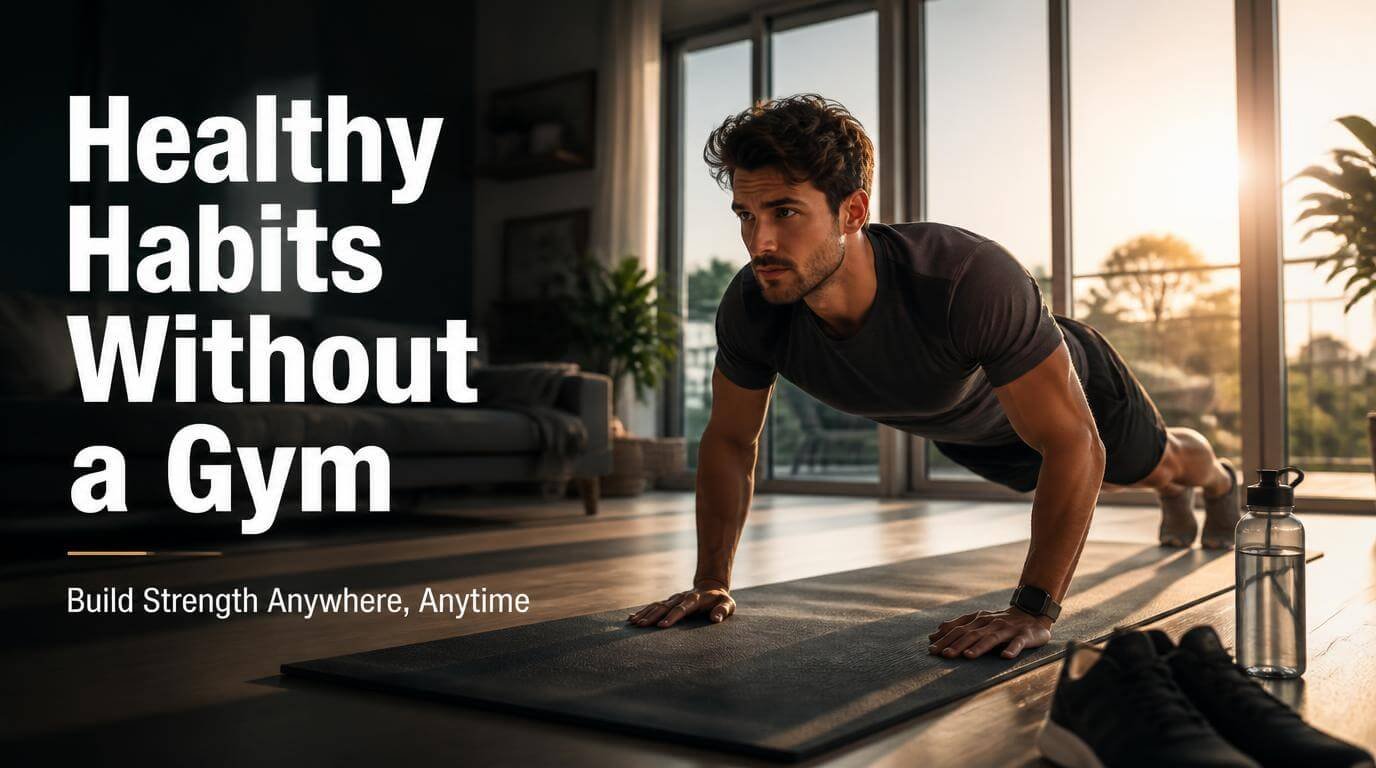
So I started small. I looked up bodyweight routines on YouTube, channels like Hybrid Calisthenics and Caroline Girvan, and realized people were getting legitimately strong using nothing but their floor. Push-ups, squats, lunges, planks, bear crawls. These movements use your own weight as resistance, and they work muscles you didn’t even know you had.
The mindset shift was the real first step. Once I stopped equating fitness with a gym building, everything opened up. I started seeing my hallway as a place for walking lunges and my kitchen counter as a surface for incline push-ups. It sounds silly until you’re sweating through your shirt at 7 AM in your living room and realizing you haven’t spent a single dollar.

Step Two: Pick Three Habits, Not Thirty
My biggest mistake early on was trying to overhaul my entire life on a Monday morning. Wake up at 5 AM, meditate, stretch, do a full workout, cook a healthy breakfast, journal. By Wednesday, I was back to hitting snooze and eating cereal over the sink.
The fix was laughably simple. I picked just three habits to build over the first month.
- A 15-minute bodyweight workout every morning
- Drinking a full glass of water before coffee
- A 10-minute walk after dinner
That’s it. Nothing flashy. Nothing Instagram-worthy. But all three stuck because they were small enough to actually do when I was tired, busy, or not feeling it. James Clear talks about this in Atomic Habits, and he’s right. The two-minute rule works. Start so small that skipping feels harder than doing it.
Once those three became automatic, around week four or five, I layered in more. But the foundation was patience with myself, not perfection.
Why Healthy Habit Building Without a Gym Membership or Equipment Works Long-Term
Here’s something nobody tells you about gym memberships: they create a dependency. If the gym closes, you’re flooded, or you travel, your routine falls apart. I watched it happen to myself and a dozen friends during COVID lockdowns.
When your habits don’t require a location or tools, they travel with you. Hotel room? You can do push-ups. Visiting your parents? You can walk the neighborhood. Stuck at home with a sick kid? Fifteen minutes on the living room floor still counts.
Consistency is the only thing that produces long-term results, and consistency gets a lot easier when there are zero barriers between you and your workout. No commute. No locker room. No waiting for the squat rack. You just start.
I’ve maintained my routine through two moves, a job change, and a vacation to Portugal. That never happened when I relied on a gym.
Step Three: Use Free Resources Like They’re Gold
The amount of free, high-quality fitness and wellness content available right now is honestly staggering. I built my entire routine using things I didn’t pay a cent for.
For workouts, I rotated between YouTube channels. Fitness Blender has hundreds of no-equipment routines sorted by length, difficulty, and focus area. For yoga and mobility, Yoga With Adriene became my go-to on rest days. For running, the Nike Run Club app offers guided runs and training plans at zero cost.
I also used a free habit-tracking app called Loop Habit Tracker on Android to keep myself accountable. Seeing an unbroken chain of green checkmarks genuinely motivated me more than any personal trainer ever did.
One thing I wish I’d known earlier: public libraries often carry audiobooks on health and nutrition through apps like Libby. I listened to The Body Keeps the Score and Why We Sleep by Matthew Walker during my evening walks. Free education while building a habit. Two birds, one stone.

Step Four: Build a Routine That Fits Your Actual Life
I cannot stress this enough. The “best” routine is the one you’ll actually do. Not the one some fitness influencer swears by while filming in their home gym full of equipment they got for free.
My routine looks nothing like what I see on social media, and that’s fine. Here’s roughly what a week looks like for me now:
- Monday, Wednesday, Friday: 20 to 25 minutes of bodyweight strength training (push-ups, squats, lunges, planks, glute bridges)
- Tuesday, Thursday: 30-minute walk or light jog around my neighborhood
- Saturday: Yoga or stretching session, usually 20 minutes
- Sunday: Full rest day, no guilt
Some weeks I swap days around. Some weeks I only get four sessions in. The point isn’t rigidity. It’s showing up more often than not.
I built this schedule by looking honestly at my mornings and evenings, figuring out where I had 20 to 30 real minutes, and protecting that time. For me, it’s right after I drop my kid at school. For you, it might be lunch breaks or late evenings. There’s no universal answer.
Step Five: Handle Nutrition Without Overcomplicating It
You can’t out-exercise a bad diet, and you definitely can’t do it with bodyweight workouts alone. But nutrition doesn’t need to be complicated or expensive either.
I stopped trying to follow strict meal plans and instead adopted three simple guidelines. Eat more vegetables than I think I need. Drink more water than I think I need. Cook at home more than I eat out.
No calorie counting. No macro tracking apps. No $200 grocery hauls full of organic spirulina powder. I started batch-cooking rice and beans on Sundays, keeping frozen vegetables stocked, and swapping my afternoon chips for an apple with peanut butter.
These changes cost me less money than my old eating habits, not more. And they paired naturally with my new movement routine. When you start exercising consistently, you actually want to eat better because you can feel the difference in your energy and recovery. The habits reinforce each other.

Step Six: Track Progress Without a Scale
Weighing myself every morning used to wreck my motivation. Water retention, a salty dinner, hormonal shifts, all of it made the number bounce around in ways that felt random and demoralizing.
So I stopped weighing myself entirely for three months. Instead, I tracked other things.
Could I do more push-ups than last week? Was I walking farther without getting winded? Did my jeans fit differently? Was I sleeping better? Did I have more energy at 3 PM instead of crashing?
Every single one of those markers improved before the scale moved much at all. And they felt way more meaningful. I started keeping a simple note on my phone where I’d jot down one thing I noticed each week. “Did 15 push-ups without stopping for the first time” hit harder than any number on a scale ever could.
Progress photos work too, if you’re comfortable with them. I took one on day one and another at day 90. The visual difference surprised me more than I expected.

Step Seven: Plan for the Days You Don’t Feel Like It
This is the part most articles skip, and it’s the part that matters most. Motivation fades. It always does. The people who build lasting habits aren’t more motivated than you. They just have a plan for the low days.
My plan is simple. On days when I absolutely do not want to work out, I commit to five minutes. Just five. I’ll do a few squats, a couple of push-ups, maybe some stretching. Most of the time, once I start, I keep going. But even if I stop at five minutes, I’ve maintained the habit loop. My brain still registers “I showed up.”
I also gave myself permission to have genuinely bad weeks without treating them as failure. Missed three days in a row? Cool. Start again tomorrow. No dramatic restart, no “I’ll begin fresh on Monday” nonsense. Just pick up where you left off.
FYI, the all-or-nothing mindset is the number one killer of healthy habits. Kick it out of your head as fast as you can.
Frequently Asked Questions
Can you really get fit without any equipment at all?
Absolutely. Bodyweight exercises like push-ups, squats, lunges, and planks build real strength and endurance. Calisthenics athletes prove this constantly. You can also increase difficulty by slowing reps down, adding pauses, or progressing to harder variations like pistol squats or archer push-ups. A gym helps, but it’s not required.
How long before I see results from bodyweight workouts?
Most people notice improved energy, better sleep, and increased strength within three to four weeks of consistent training. Visible physical changes usually show up around the six to eight week mark. The key word is consistent. Three short sessions per week beats one long session every ten days.
Is healthy habit building without a gym membership realistic for busy people?
It’s actually more realistic for busy people. You eliminate commute time, locker room time, and waiting for equipment. A solid bodyweight workout takes 15 to 25 minutes in your living room. Pair that with a short walk, and you have a complete routine that fits into almost any schedule without rearranging your whole life.
What if I get bored doing the same exercises at home?
Switch things up regularly. Follow different YouTube trainers each week, try new bodyweight progressions, add a dance workout or yoga session. Boredom usually comes from doing the exact same routine for months. Even small changes, like reversing your exercise order or adding a finisher, keep things fresh.
Do I need protein supplements if I’m not going to a gym?
Not necessarily. Most people get enough protein through regular food, things like eggs, chicken, beans, Greek yogurt, and tofu. Supplements are convenient, not essential. If you eat balanced meals with a protein source at each one, you’re probably covered. Save your money unless a doctor or dietitian specifically recommends it.
Conclusion
Building a strong, sustainable fitness routine with nothing but your body and free resources isn’t a hack or a shortcut. It’s honestly the most grounded approach I’ve ever tried, and the only one that’s lasted more than a few months for me. What’s the smallest habit you could start with tomorrow morning?